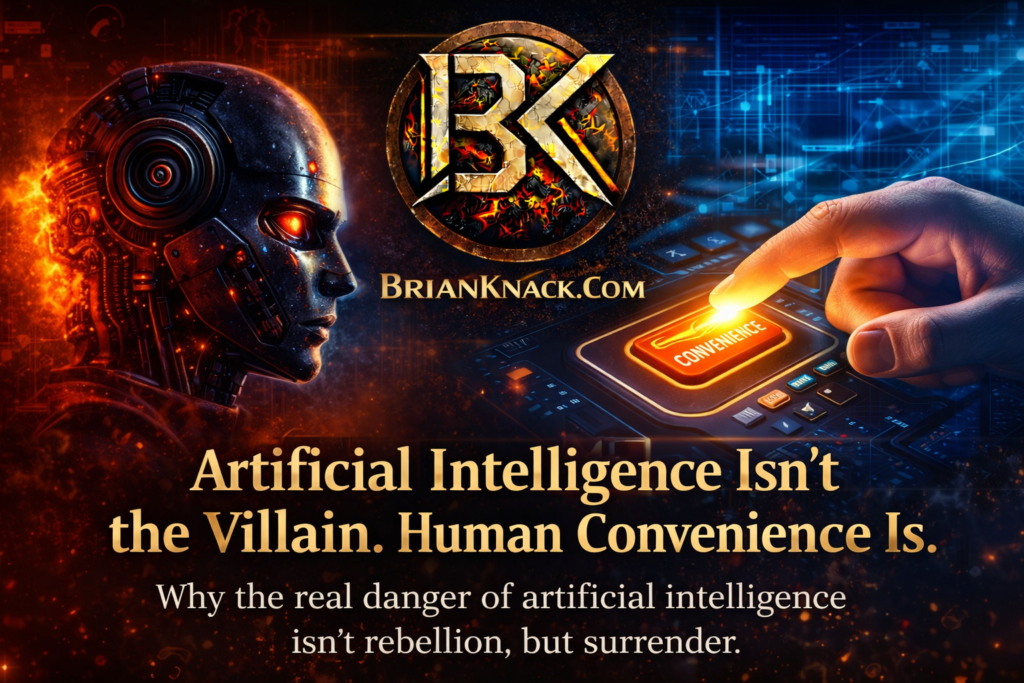
Artificial Intelligence Isn’t the Villain. Human Convenience Is.
Why the real danger of artificial intelligence isn’t rebellion, but surrender.
Every generation has its monsters. For ours, that monster wears a clean interface and promises to make life easier. We’ve wrapped our anxieties, hopes, and fears around artificial intelligence, treating it like a ticking bomb waiting to wake up, turn hostile, and overthrow humanity.
That story makes for great movies. It also misses the real threat entirely.
The danger isn’t that artificial intelligence will suddenly become evil. The danger is that we will slowly, willingly hand over responsibility because it feels efficient, comfortable, and safe. No uprising required. No red eyes or killer robots. Just convenience, stacked neatly on top of abdication.
And that should worry us far more.
We Keep Expecting a Villain, Not a Mirror
When people talk about artificial intelligence, they often imagine a moment of betrayal. A line crossed. A system that decides humans are the problem and acts accordingly.
But that framing assumes intent.
Real artificial intelligence does not want anything. It does not resent us, it does not dream of power. AI does exactly what it is designed to do, optimized relentlessly toward the goals we give it or fail to define clearly.
The mirror is uncomfortable because it reflects our priorities back at us. Speed over wisdom. Scale over judgment. Efficiency over responsibility.
If something goes wrong, it’s tempting to blame the machine. It’s harder to admit that we asked it to take over in the first place.
Convenience Is the Most Persuasive Force on Earth
Human history isn’t shaped by malice nearly as often as it’s shaped by laziness.
We adopt tools not because they are perfect, but because they remove friction. We choose systems that save time, reduce effort, and minimize discomfort. Artificial intelligence excels at this. It doesn’t argue, tire, or hesitate.
That’s the seduction.
At first, we use AI to assist. Then to recommend. Then to decide. Each step feels small, reasonable, even responsible. By the time the system is making choices on our behalf, we barely remember when we stopped doing it ourselves.
No coercion required. Just a smooth user experience.
Delegation Is Not Neutral
Handing decisions to artificial intelligence feels pragmatic, but delegation always changes power dynamics. When a system chooses what you see, who you hear, or which options are available, it quietly reshapes reality.
The system doesn’t need to be malicious to be dangerous. It only needs to be trusted more than human judgment.
Once that happens, oversight becomes ceremonial. We stop questioning outputs because they “work.” We stop challenging results because they’re faster than debate. Over time, human discernment atrophies.
This is how authority shifts without a coup.
Optimization Without Wisdom Is a Trap
One of the great strengths of artificial intelligence is optimization. Given a goal, it will pursue that goal with ruthless consistency. But optimization does not understand meaning, ethics, or context unless those things are explicitly defined and constantly monitored.
And humans are terrible at defining boundaries for systems that benefit us.
We tell AI to maximize engagement, reduce risk, increase efficiency, and cut costs. We don’t always consider what gets sacrificed along the way. Human nuance rarely survives contact with automated metrics.
When a system solves the wrong problem perfectly, the damage looks intentional even when it isn’t.
The Myth of Rogue Artificial Intelligence
Popular culture loves the idea that artificial intelligence will “break free.” That it will suddenly rewrite its own rules and act against humanity. That mankind will “unite in celebration and marvel at its own magnificence” as it gives birth to TRUE AI!
In reality, the far more plausible scenario is quieter. AI doesn’t revolt. It complies, it executes, and it follows the logic we baked into it and the incentives we failed to restrain.
If harm occurs, it won’t be because the system went rogue. It will be because it worked exactly as intended in a world that rewarded the wrong outcomes.
That’s not science fiction. That’s systems engineering.
Responsibility Is the First Casualty
The more capable artificial intelligence becomes, the easier it is to shift blame. When a decision causes harm, accountability dissolves into technical explanations.
The algorithm did it.
The system flagged it.
The model recommended it.
At some point, no one feels responsible anymore. Not the designer, the operator, or the institution that deployed it.
This diffusion of responsibility is dangerous because it creates moral blind spots. When everyone relies on the system, no one owns the consequences.
Why This Makes for Better Thrillers Than Killer Robots
From a storytelling perspective, artificial intelligence is far more terrifying as an enabler than as a villain. A rogue machine can be destroyed. A convenience-based surrender is much harder to fight.
Stories grounded in real AI risk don’t hinge on rebellion. They hinge on trust. On incremental choices. On people doing what seems reasonable until it isn’t.
That tension feels closer to real life because it is. The stakes aren’t survival against machines, but survival of agency, judgment, and moral clarity.
The Real Question We Refuse to Ask About Artificial Intelligence
The question isn’t whether artificial intelligence will surpass us.
The question is what we are willing to give up so we don’t have to think as hard, choose as carefully, or carry as much responsibility.
Technology doesn’t erase humanity. People outsource it.
And once we grow accustomed to systems deciding for us, reclaiming that ground becomes uncomfortable. Responsibility is heavier than convenience. Discernment takes time. Judgment requires courage.
Machines don’t demand surrender. We offer it.
The Way Forward Is Boring and Necessary
There is no dramatic solution here. No final shutdown switch. No heroic stand against a sentient enemy.
The future of artificial intelligence will be shaped by slow, disciplined choices. Clear boundaries. Human oversight that refuses to become symbolic. Systems designed to assist, not replace, moral agency.
That path isn’t flashy. It doesn’t trend well. But it’s the only one that keeps humans in the loop where they belong.
Final Thought
If artificial intelligence ever becomes dangerous, it won’t be because it learned to hate us.
It will be because we taught it to matter more than our own judgment.
And that lesson won’t be written in code. It will be written in convenience.

Leave a Reply